
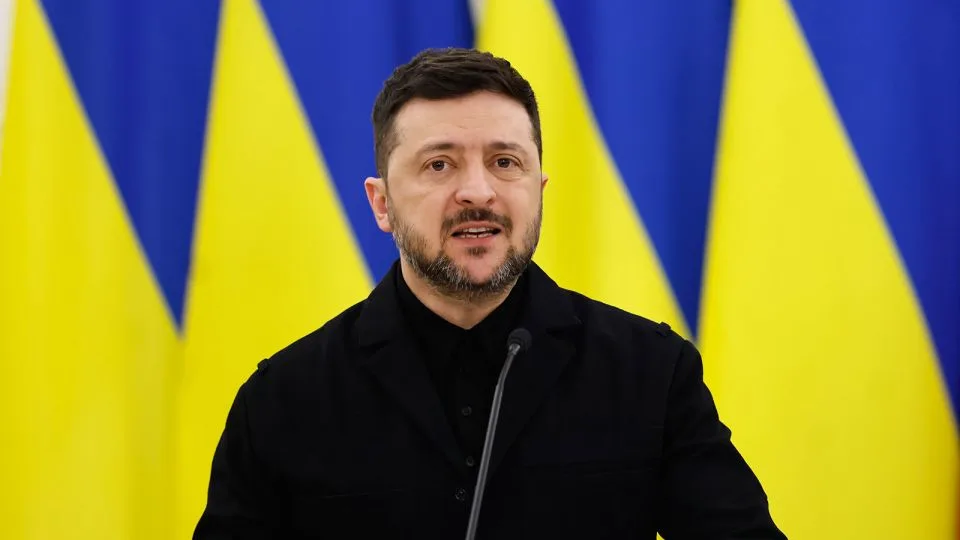
Zelenskiy blasts Trump’s diesel deal and calls Russian peace moves a ‘parody’
By Lili Bayer, Andrew Gray and Yuliia Dysa
BRUSSELS/KYIV, Oct 16 (Reuters) – Ukrainian President Volodymyr Zelenskiy took aim on Friday at US President Donald Trump’s diesel deal with Russia and welcomed the prospect of European allies stepping up their role in talks, calling Moscow’s stance a “parody” of peace negotiations.
At a European Union summit in Brussels, Zelenskiy said Russia did not want peace. He added that Ukraine was still experiencing disruptions to the SpaceX Starshield satellite system used for battlefield operations and to down Russian drones attacking cities far from the frontline.
EU leaders rallied around Zelenskiy after Trump again criticised Ukraine, calling its strikes on Russian refineries a “disgrace”. On arriving at the summit, Zelenskiy pointedly referred to his counterparts there as “real leaders”.
The EU was hosting Zelenskiy at one of the most difficult moments for Ukraine, with missiles and drones raining down on Ukrainian cities and fears that the US could pull back intelligence sharing and weapons support from Kyiv.
Nevertheless, Zelenskiy’s tone suggests he has little intention of softening his stance towards the US. Asked at a press conference whether he felt he was being used as a scapegoat by Trump for high energy prices and the trajectory of the Iran war, Zelenskiy paused for a long time, smiled, and said “this is my answer”, to laughter in the room.
‘MONEY IN PUTIN’S POCKET’
Trump blindsided Zelenskiy last weekend by announcing that Ukraine and Russia had agreed not to target each other’s energy facilities. Facing US midterm elections in November, Trump has blamed Ukrainian strikes on Russian refineries for pushing up energy prices that could cost him at the ballot box.
His diesel deal with Russia angered Ukraine and European allies.
“And now we can see how cash will start flowing back into Russia through the diesel deal,” Zelenskiy told the press conference on the sidelines of the summit.
“This diesel deal will never be enough to offset the impact of the Strait of Hormuz on global markets. But it will put more money straight into Putin’s pocket to fund this war.”
Zelenskiy also accused Russian President Vladimir Putin of not being interested in peace talks in any form.
“Putin does not want peace talks at the moment, in any form,” he said. “He’s playing with words, claiming they respond… Quite simply, it looks like a parody of a genuine desire to end the war.”
The Kremlin said last week that Ukraine had undermined the possibility of an immediate resumption of peace talks after it had hit Moscow with drones during last month’s election.
Meanwhile in the latest attacks in Ukraine, Russian drone strikes on the city of Kharkiv killed three people, while strikes elsewhere left hundreds of thousands of people without power.
In an interview, Estonian Prime Minister Kristen Michal told Reuters that the EU would probably have to provide a new loan to Ukraine to help cover its budget gap for next year.
“Last winter was already hell, this one will be once again like hell,” Michal said.
“The war will cost €155 billion next year. And we need at least €70 billion more from you – for defence, for weapons, and for our resilience,” Zelenskiy said in his address to the EU leaders, which he later posted on X.
“This is a realistic amount. And I ask you to find this support. It will help us hold Russia back.”
ADVERTISEMENT
¡Secure Your
Paradise Today!
Your next exclusive
real estate investment.
Don’t miss the opportunity to acquire a unique property with a prime location, high profitability, and complete legal security. Watch our exclusive 28-second video on the right and discover the project that will change your future.
- Premium Location: Exclusive areas with high appreciation potential.
- Design and Comfort: Modern spaces ready to enjoy or rent out.
- Total Guarantee: Expert guidance at every step of your purchase.
EU LEADERS GRAPPLING WITH BUDGET
Ukraine’s leadership has been alarmed by disruptions to the Starshield satellite system.
A US official has denied that Trump ordered a deliberate slowdown of Starshield, which is the military-grade version of the Starlink service run by Elon Musk’s SpaceX, and Trump said this week intelligence sharing with Ukraine continued.
Zelenskiy said the operation had improved but not yet been fully restored, adding the disruption placed civilians at risk.
“Starlink is really necessary for Ukraine. And unfortunately, in short term, Europe can’t replace this capability,” said the EU’s foreign policy chief Kaja Kallas.
Ukraine struck a Russian oil refinery after Zelenskiy declared that Kyiv was abandoning the energy ceasefire that Trump had announced.
“All he’s doing is making the world oil price higher. Well, I think that’s a disgrace,” Trump said in an interview with the Newsmax news outlet.
Russia has also publicly acknowledged the drone attack on a refinery and broadcast images on state media, breaking with its usual practice in order to play up the incident.
While EU leaders hit out at the US deal to buy Russian diesel, they are also grappling with how to tackle energy prices that have soared since the Iran war, exposing divisions between member states on day one of the summit on Thursday.
Splits continued on Friday, with Swedish Prime Minister Ulf Kristersson saying member states were “incredibly far apart” from each other when it came to finalising the EU’s own budget. “There isn’t even a glimpse, as they say, a shred of agreement on this,” he said.
Reporting by Andrew Gray, Bart H. Meijer, Philip Blenkinsop, Charlotte Van Campenhout, Louise Rasmussen, Lili Bayer, Andreas Rinke, Yuliia Dysa, Max Hunder; Writing by Matthias Williams; Editing by Alex Richardson
ADVERTISEMENT

On Friday, October 9, Trump announced on Truth Social that he had reached an agreement with Putin during a phone call. The deal would let Moscow release large amounts of diesel onto global markets in exchange for sanctions relief. Shortly afterward, the Treasury Department issued a temporary license authorizing Russian diesel to be supplied to the global market. ‘This is not how partners behave’: Zelensky furious over Trump’s Russia deal +2
Ukrainian President Volodymyr Zelensky reacted sharply. In an interview with Axios, he called the decision “not fair and not honest,” and the outlet reported that he seemed to feel betrayed. He added that he would have backed easing energy sanctions only in exchange for halting attacks on energy facilities during the winter. Another outlet reported that he described the deal as an investment in a war that must be ended. Axiosmoderndiplomacy
Tensions rose further on Saturday. Zelensky linked the deal to a Russian attack on Zaporizhzhia: he said Russia had “thanked” the US for lifting diesel sanctions by dropping five glide bombs on residential buildings. Casualty figures vary by source: AFP reported 15 dead and Reuters reported 20, including three children. Trump responded by saying Ukraine should “get a new leader,” and accusing Zelensky of blocking a deal with Moscow and ignoring instructions not to strike Russian refineries. EU foreign policy chief Kaja Kallas warned that lifting sanctions on Russian diesel would help fuel the Kremlin’s war.
Analysis
1. A shift in the pressure policy on Russia. The United States has not imported Russian oil or gas since 2022. Washington easing sanctions without a visible Russian concession marks a significant change, and Zelensky asked precisely what the US got in return. Even sources cited by Israeli media acknowledged that the deal weakens Ukraine’s negotiating position. itv
2. The US domestic factor. It is hard to separate the deal from the political calendar. Trump faces pressure over fuel prices weeks before the November 3 midterm elections, where Republicans have dim prospects partly because of energy costs. Trump himself said lowering prices for Americans is his priority. This does not prove the deal is purely electoral, but it helps explain the timing. khaleejtimes
3. The dispute over refineries. According to Axios, Trump moved ahead with Russia after Kyiv ignored Washington’s requests to stop attacking Russian refineries. For Ukraine, those strikes are a tool to cut Moscow’s war revenue. For Washington, they affect supply and prices. That is the core of the clash.
4. Europe in the middle. Kallas sided with Kyiv, while Zelensky also criticized the EU’s decision to lift sanctions on two Russian oligarchs as part of a deal to extend other restrictions. The Western front is not as united as it is often presented.
5. What comes next. Russia has already publicly welcomed the deal. If the announced shipments go ahead, the real test will be the effect on prices and on Russian finances. Meanwhile, Trump’s pressure on Zelensky, including the suggestion of replacing him, complicates any peace negotiation before winter.
Conclusion
The episode exposes an open rift between Washington and Kyiv. The US prioritizes energy prices and a quick deal, while Ukraine fears every concession to Moscow funds more attacks. Whether the conflict moves toward peace or deeper attrition will depend on whether Russia offers concrete concessions and whether Ukraine’s allies can agree on a common stance.
This news story was edited and published with the help of AI.


