Britain’s new prime minister, Andy Burnham, vows to end years of instability
By Elizabeth Piper, Andrew Macaskill and Alistair Smout
LONDON, July 20 (Reuters) – Andy Burnham became Britain’s seventh prime minister in a decade on Monday, pledging to reshape its politics to deliver a new economic model and revive a nation “fed up” with a revolving door of leaders.
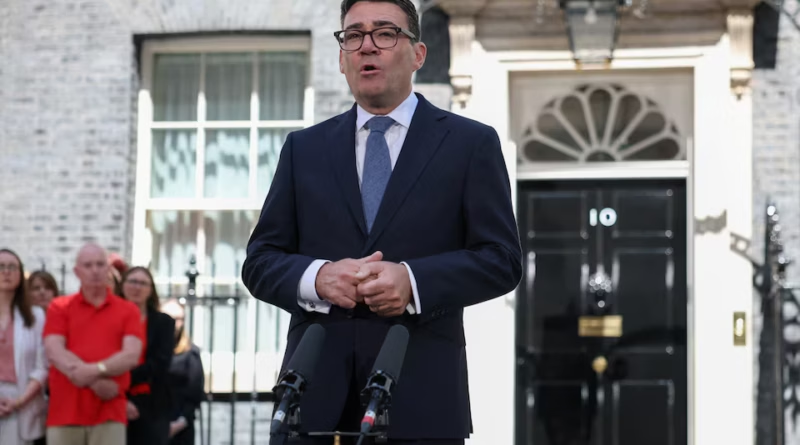
In front of dozens of supporters outside his new office and residence at 10 Downing Street, Burnham said politicians had failed to bring the stability needed to raise living standards, something he said he would change, with both immediate measures and a longer-term plan to be drawn up later this year.
Speaking without notes, Burnham delivered a domestic-focused speech aimed at offering hope to a nation that has, like many European countries, struggled for years with soaring prices and anaemic economic growth. He did not touch on foreign affairs.
“I know people at home are fed up with politics. I hear you, and I want to be honest with you, we have not been good enough and we need to be better,” he said, dispensing with the lectern that prime ministers generally use.
Burnham pledged to use his premiership as a “circuit-breaker for Britain”, arguing that a new model was needed to rebuild the country, which has been in political turmoil since voting in 2016 to leave the European Union.
ADVERTISEMENT
¡Secure Your
Paradise Today!
Your next exclusive
real estate investment.
Don’t miss the opportunity to acquire a unique property with a prime location, high profitability, and complete legal security. Watch our exclusive 28-second video on the right and discover the project that will change your future.
- Premium Location: Exclusive areas with high appreciation potential.
- Design and Comfort: Modern spaces ready to enjoy or rent out.
- Total Guarantee: Expert guidance at every step of your purchase.
BURNHAM PROMISES 10-YEAR PLAN, BUT NOT FOR SEVERAL MONTHS
Just over an hour after his predecessor and Labour colleague Keir Starmer had made his farewell speech to say “My work is done”, the 56-year-old former Greater Manchester mayor entered Downing Street, where he said his team would tackle his first priority: to end rough sleeping.
The major challenges will then lie ahead.
Burnham must first unveil his cabinet — already the subject of much debate in the Labour Party — and then tackle a long list of problems ranging from high levels of illegal immigration to underperforming utility firms.
Starmer, ousted by his own lawmakers a month ago, said his work as prime minister was “the privilege of my life” and that he wished Burnham every success, with “my full support”.
Burnham did not refer to Starmer in his speech, instead focusing on how he will bring change. But he acknowledged that some of his programme would take time.
In his short address, thin on policy detail, Burnham said he would release a long-term plan for the next decade within months and repeated his pledge to build more public housing and to help bring down welfare spending to fund higher defence investment. Opposition parties suggested he would need to win a national election to get a mandate to implement it.
But he promised to unveil more immediate measures on Tuesday to ease everyday pressures on Britons, and explain how he will pay for them.
Speaking to reporters later on Monday, Burnham said he was finalising the details of those measures which he described as “things that people will feel and feel quite quickly”.
“It won’t solve everything, it won’t take all of the pressure off, but it just shows the direction of travel and … about helping them out,” he said, not long after arriving in Downing Street and before he started unveiling his top team.
ADVERTISEMENT

Dubbed ‘King of the North’ for his dogged defence of the Manchester region’s interests, Burnham received messages of congratulation from foreign leaders, including European leaders who called for closer ties.
His first phone call was with U.S. President Donald Trump, a White House official said. Burnham also said he wanted to speak to Ukrainian President Volodymyr Zelenskiy, for whose country he expressed continued support.
LABOUR PARTY BACKS BURNHAM TO OVERCOME SURGING REFORM UK
Labour lawmakers see Burnham as one of the few figures capable of tackling the threat from veteran Brexit campaigner Nigel Farage’s populist Reform UK – something they doubted the unpopular Starmer could do.
A key first decision will be Burnham’s choice of finance minister after Rachel Reeves was one of several Starmer allies to say she was leaving the government. Friction in this axis of government has brought down previous administrations.
An early frontrunner for the position, energy security and net zero minister Ed Miliband, has been the object of hostile briefing, and interior minister Shabana Mahmood now appears favourite for the job.
On Sunday, Burnham scrapped plans for all employees to be required to hold a digital identity document, a scheme designed to tackle illegal migration but deemed a “fiasco” by a cross-party committee of lawmakers..
More attention will be paid to decisions on taxation and spending, oil and gas, and underperforming utility companies, where Burnham wants stronger public control.
New British Prime Minister Andy Burnham has said he may ask people to pay “a little more” in tax as the country faces major spending pressures from an ageing population and a need to rebuild its armed forces as well as broader investment goals.
Tax as a share of British economic output is already forecast to rise to 37% this year — its highest since 1948 and more than in the United States or Japan, but below other big European countries with more generous state pension provision.
Burnham has said he will keep the fiscal rules of finance minister Rachel Reeves, which require him to balance day-to-day spending with tax revenues within three years.
He has also backed Labour’s 2024 pre-election manifesto which ruled out many tax increases.
Last week the International Monetary Fund said the government should reprioritise existing spending before raising taxes further.
Following are some of Burnham’s options if he does choose to raise taxes.
INCOME TAX, NATIONAL INSURANCE AND VALUE-ADDED TAX
Labour’s 2024 manifesto ruled out increasing the rates of income tax, national insurance or value-added tax, which together account for nearly two thirds of total tax revenue.
However, Reeves did increase the employers’ component of national insurance payments by £26 billion ($35 billion) a year in her first budget, arguing it was not covered by a pledge not to raise taxes on working people.
Labour, like previous governments, has also frozen the salary levels at which the 20%, 40% and 45% rates of income tax become payable, meaning average tax rates rise as wages go up over time. Thresholds are already frozen until 2031, so cannot become an immediate source of new revenue, but would raise £5 billion a year if frozen beyond that.
Last week the OECD said Britain should review VAT exemptions — which range from most food to ebooks. Pensions minister Torsten Bell said such a change would be inconsistent with government attempts to cut the cost of living, which Burnham also prioritises.
Burnham has previously spoken in favour of a lower 10% VAT rate for hospitality businesses and in a Times interview on Monday he noted public concern that the starting threshold for paying income tax had stayed frozen at £12,570.