
What New York’s Only Legal Foraging Space Reveals About Climate and Access
written by Jaden Schapiro
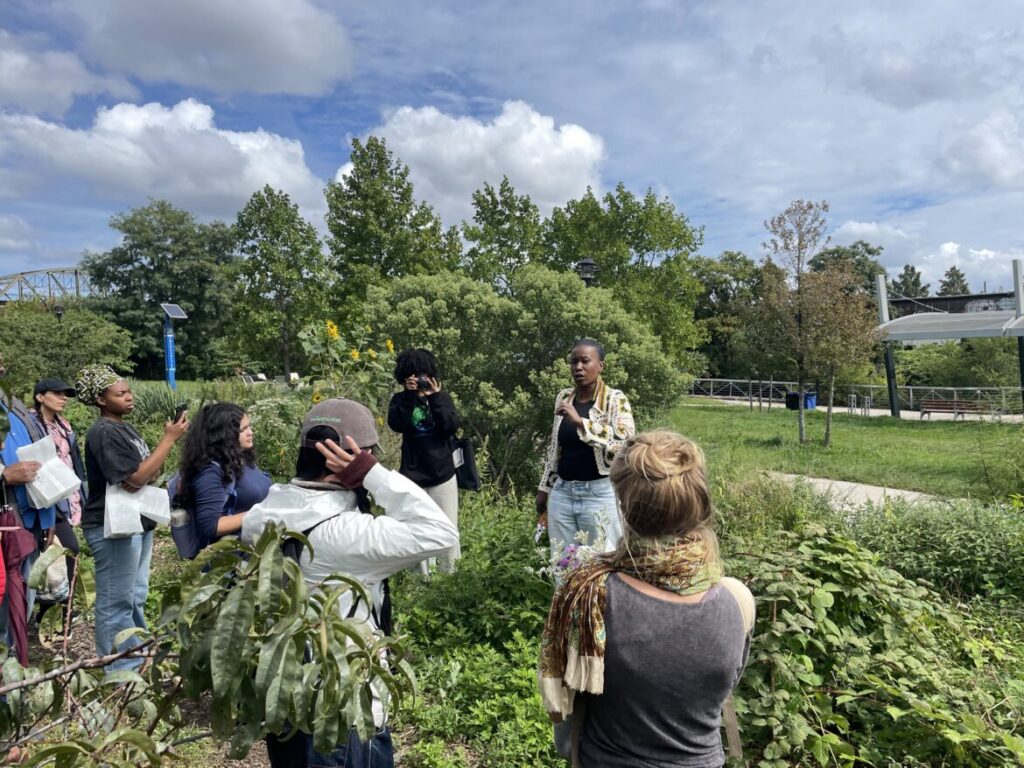
Among Longwood’s overhead trains, highways, and autobody shops is a sliver of green with New York City’s first and only legal public foraging space, the Bronx River Foodway. The project is located at the mouth of Concrete Plant Park and stretches along its western fence, opposite the Bronx River. Many of those in the park are deliveristas zooming through or those on a stroll. But for a handful of Bronx residents—a large portion of whom identify as Black and Latino and live in the city’s most food insecure borough—the Foodway is a vital source of nutrition, medicine, and community.
For this year’s Climate Week NYC, an annual citywide event series that gathers those interested in climate-conscious initiatives, the Bronx River Alliance (BRA) and Holes in the Wall Collective (HITW) collaborated on a “Bronx River Celebration” that centered urban foraging at the Foodway.
Foraging is an intimate way to engage with hyperlocal ecology and how the climate emergency is shaping it, and with only one sanctioned site in the city, New Yorkers who don’t live near Longwood can’t access the Foodway every day or as easily. Foraging is prohibited in nearly all NYC parks under Parks Department regulations, which makes the Foodway a rare exception.
Concrete Plant Park was a concrete plant up until 1987, when the Transit-Mix Corporation shut it down. According to Jennifer Seda, the Volunteer Program Assistant at the BRA, and HITW co-founders Julia Meeks and Dhira Rauch the grounds then became a tire lot, but were never devoid of life. They detailed how squatters moved in at one point and local residents engaged in guerrilla rice farming, among planting other crops.
It wasn’t until 2000 when the lot was transferred to NYC Parks, and, in 2009, it officially opened to the public. Its formal transformation was a collaboration between the city agency, the BRA, and additional local organizations. The Foodway pilot, also a combined effort, opened in 2017.
The Climate Week event was intended to educate attendees, many of whom travelled from outside of the Bronx, about how to forage and foraging’s benefits. “Focus on senses and intuition,” said clinical herbalist and foraging practitioner Journei Bimwala, who is also a founding member of the Foodway. She encouraged attendees to “Leave our intellect behind” and “Use the senses we were naturally born with.” For her, foraging is firstly being aware and present.
According to Bimwala, using your eyes and mindful observation can help with more than just identifying edible plants. Foraging puts you in the “right time,” where plants can be used as precise indicators for seasons, environment, and time. An example she used was the abundant goldenrod in the Foodway, which signals a transition into the fall harvest season.
ADVERTISEMENT
¡Secure Your Paradise Today!
Your next exclusive real estate investment.
Don’t miss the opportunity to acquire a unique property with a prime location, high profitability, and complete legal security. Watch our exclusive 28-second video on the right and discover the project that will change your future.
- Premium Location: Exclusive areas with high appreciation potential.
- Design and Comfort: Modern spaces ready to enjoy or rent out.
- Total Guarantee: Expert guidance at every step of your purchase.
For those at the Foodway, foraging is also a particularly useful “preparation of what’s to come,” said Bimwala. In one sense, that same goldenrod, when dried and used as a tisane, can, in her experience, work as a medicine for the later-sprouting and common allergen ragweed. In another sense, “What you see in our environment,” she said, “is mirroring our society.” Dedicated foraging foodways are a demonstration of how local ecosystems are adapting to a changing climate: they indicate which plants can and can’t grow without significant human intervention and how abundantly.
The National Oceanic and Atmospheric Administration’s (NOAA) National Climate Assessment reclassified New York City’s climate from “humid continental” to a “humid subtropical” in 2020 using the Köppen climate classification system. (Unfortunately, the second Trump administration shut down the National Climate Assessment last year). The Köppen system uses temperature and precipitation to determine classifications and how they might change; foragers at the Bronx River Foodway also use the plants they see in front of them because plants are specific to certain climates themselves. Bimwala noted that she has witnessed this “settle” into the city’s new subtropical climate from continuously late goldenrod blooms every summer.
The culture and language surrounding the climate are often expressed with a sense of urgency, doom, and impending disaster (For example, the movement to modify the name of “climate change” to “climate emergency” or “crisis”) and for a justifiable reason: a global average surface temperature of 1.28 degrees Celsius above pre-industrial levels so far has contributed to more wildfires, more intense hurricanes, more droughts, and rising sea levels. Those events then create dire circumstances, such as forced relocation, inconsistent crop yields, and much more. Developing countries largely bear the brunt of those circumstances.
ADVERTISEMENT
In 2023, Hunter said the Foodway was made an exception to the law because “a former Parks bureaucrat was sympathetic to the cause” of the BRA, its clean up of the Bronx River, and its efforts to create a new kind of foraging space.
There are a few arguments for keeping foraging restricted. The first is contamination. Could foraging New Yorkers unknowingly be consuming plants grown in a city with polluted air, water, and soil? Bimwala believed that concern isn’t valid because “we already have the toxicity inside us” just by living in New York. The BRA still checks for pollutants, however. In 2022, the organization began its partnership with Cornell University to help test for soil contaminants with an X-ray machine.
NYC Parks, meanwhile, seems to believe that New Yorkers have enough garden space. When writer Sabina Sethi Unni asked the agency why foraging is illegal, “they pointed me in the direction of ‘one of 550 GreenThumb community gardens’ instead,” she reported. But that only matters if your neighborhood has a community garden in the first place.
A more controversial barrier might be what former USDA Forest Service researcher Paul H. Gobster called the “museumification” of urban parks, where policy maintains parks solely “as a source of aesthetic appreciation and passive re-creation to city dwellers.” Anti-foraging laws in the United States have historically prevented Black and Indigenous peoples from maintaining traditional, secure, and self-sufficient practices outside of colonial and mainstream food systems.
The event was staunchly committed to revitalizing that same Indigenous history and contextualizing its relationship to the park. Performances from award-winning Nuyorican poet LA BRUJA (Caridad de la Luz) were interspersed throughout our foraging and she reminded attendees of the Bronx River’s Mohican name, the Aquehung. She and Bimwala encouraged us to be mindful foragers (For example, only take what you need and give back what you don’t). Meeks and Rauch also shared their Munsee-Lenape ancestry and ties to the Foodway’s land. The event concluded with a water prayer ceremony led by healing arts practitioner Graciela Fairy Hawk.
As New York City’s climate continues to shift, Bronx River foragers will continue to adapt with it. According to Seda, the BRA is looking to grow and strengthen its foraging network and communities: the organization holds its annual Foragers Gathering every February and is looking to form a “Food Forest Coalition.”
“We would love to see more sites like the Foodway throughout the city,” added Seda, “while also making sure that more New Yorkers know about and have opportunities to engage with the spaces that already exist.”
Jaden Schapiro is a senior writer and researcher at the NYC Food Policy Center.


