The Stories THE CITY Will Be Watching in 2026
by THE CITY
The new mayor and his agenda loom large in the new year, from child care to climate policy to the housing crisis.
It’s a new day in New York City, with a new year and new mayor. There’s a lot to cover, from housing to public safety. Here are some of looming issues, problems and controversies that the reporters in our newsroom can see making headlines over 2026.
One big theme, of course, is how Mayor Zohran Mamdani will govern, and enact his many campaign promises. But the city is much bigger than who’s in City Hall, and we’ll be keeping our eye on much more across the boroughs.
Friends (or Foes) of the Mayor
In 2026, I’ll be focusing a lot on relationships. Not my own, but the ones Mamdani has with everyone he’ll need to enact his affordability agenda.
Let’s start with the City Council, which shares City Hall with the mayor’s office (with the reporters in the middle). The new speaker, Julie Menin, is aligned with Mamdani on child care but is more moderate, and I expect some clashes.
Up the Thruway in Albany, Gov. Kathy Hochul is running for re-election and will be mindful of her relationship to the mayor and his further-left followers as she fights off Republican challengers. And Mamdani will need her help to pay for child care and his promised fare-free buses, for which he is seeking tax hikes.

And of course there’s Mamdani’s relationship to Trump, who could dole out or claw back money to keep the city safe, residents fed and infrastructure built. — Katie Honan
Universal Child Care
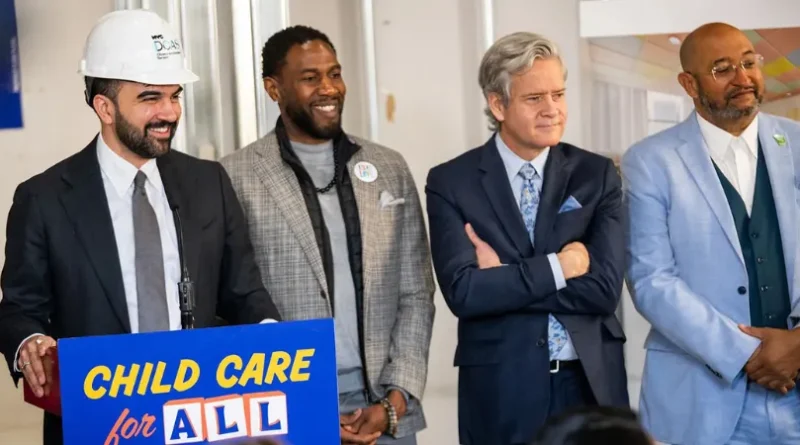
Mamdani’s most popular signature campaign issue, enacting child care for every child in New York City over the age of six months, is also his most costly — and, ironically, the one with the greatest chance of success.
Gov. Kathy Hochul and incoming council Speaker Julie Menin, both moderate Democrats, back Mamdani’s plan, as do the leaders of both branches of the state legislature. In fact, Hochul said the issue is a priority for 2026 that she wants to enact it statewide. All the governor and the mayor need to do is agree on how to fund it.
The plan is estimated to cost about $6 billion per year in the five boroughs, and $15 billion statewide. To make it happen, Mamdani proposes raising taxes on New Yorkers across the state earning more than $1 million per year. Though Hochul has said she is adamantly opposed to raising income taxes for anybody, she has expressed openness to other tax hikes.
Many families pay upwards of $20,000 a year on day care — their largest expense besides housing. Universal child care would generate $900 million in personal income by helping 14,000 women return to the workforce, according to a report last year from the city comptroller’s office. — Claudia Irizarry Aponte
Mamdani, the Boss
The new mayor enters office having made ambitious promises for the city’s working class and one important story is how the democratic socialist will contend with the work of being the boss of the city’s 300,000 civil servants. That will inevitably involve tough decisions and compromises as the city faces a rocky fiscal outlook.
His administration will have to settle new contracts with the city’s two largest unions, District Council 37 and the United Federation of Teachers, which expire in 2026. Then there’s the question of how his administration will address a financial crisis in city employee health care funding, following a devastating audit from the city comptroller’s office.
Meanwhile his promise to enact universal child care, which brings the potential for thousands of new union jobs, is backed by Gov. Kathy Hochul though questions remain about how it will be funded.
City Hall’s labor relations will be key to keeping taxpayers, and his base of low-income workers, happy. Mamdani could earn some early goodwill by working with the City Council to pass wage boosts for paraprofessionals, or by building on Mayor Eric Adams’ pilot offering remote work for some civil servants. — Claudia Irizarry Aponte
Building on Adams’ Housing Agenda
In just four years, the Adams administration made changes to the zoning laws that could produce about 130,000 new housing units amid the city’s housing crisis. But those units will only be built if Mandani continues efforts to spur development, especially in the neighborhoods that have been most resistant to new housing, especially those that bring in below-market affordable units.
Mamdani has been clear that he believes more housing is needed and even voted on his ballot for three City Charter amendments designed to ease the approval process — though he didn’t announce his support of those measures, which passed easily, until Election Day. And Mamdani’s appointment of Leila Bozorg as deputy mayor for housing who worked in the Adams Administration won plaudits from pro-housing groups.
But those same groups say that bills passed by the City Council at the end of the year will mean less housing by mandating higher wages and imposing other costly requirements. Adams vetoed all them except one that imposes a $40 minimum wage requirement on affordable projects financed by the city, leaving it up to the next Council — influenced by Mamdani — to decide whether they become law. — Greg David
An Actual ‘Bus Mayor’?
Mamdani rode to office, in part, on his campaign pledge to speed the city’s notoriously slow buses — and to make them free.
His predecessor at City Hall famously flopped on his own promise to be the “Bus Mayor,” repeatedly failing to meet a mandate to build 150 new miles of bus lanes designed to speed service along some of the slowest routes anywhere in America. Mamdani wants to shift into forward gear while eliminating the newly increased $3 fare for buses, a proposal that would require cutting a deal with Gov. Kathy Hochul.
But the fare-free proposal, which Mamdani began floating three years ago as a Queens Assembly member, faces resistance from the MTA, which operates the service. In the last three months of 2025, fares on more than 44% of all bus trips went unpaid, according to the authority’s own data. Janno Lieber, MTA chairperson and chief executive, has cast doubt on the annual price-tag of at least $700 million to make the buses free to ride. — Jose Martinez
The State of Immigration Enforcement
Immigration and Customs Enforcement arrests surged in New York City in 2025, as President Donald Trump returned to office. A focus on detaining people at immigration courthouses and at ICE check-ins has shifted more recently to seemingly random street arrests.

It’s still unclear how the Trump administration will handle a more adversarial mayor, with the two having an oddly cordial meeting at the White House after Mamdani’s historic win in November. In a city of immigrants, where about one in every nine of residents lives in a mixed-status household, THE CITY will continue to track ICE’s enforcement efforts and the broader impact of the Trump administration’s policies on New Yorkers. — Gwynne Hogan
Rikers Reform
The city’s troubled Department of Correction will soon be run, in part, by a so-called remediation manager overseen by a federal judge. The potential candidates have been under review since May. The city’s jails will also have a yet-to-be-named new commissioner. How will that person work with the remediation manager? Who will have final say? That all remains to be seen.
Another major challenge facing Mamdani will be how he tackles a law designed to strictly limit the use of solitary confinement. Former Mayor Eric Adams has repeatedly signed emergency executive orders declaring that the new rules must be put on hold.
Mamdani will also inherit a jail population that has steadily gone up over the past five years, to 6,896 as of Dec. 22 from a pandemic-era low of roughly 3,800. By law, Rikers Island must close next year, and the jails under construction to replace it will collectively hold fewer than 5,000 once completed. — Reuven Blau
Department of Community Safety
Mamdani’s most significant proposal to reform policing is the creation of a Department of Community Safety, which he has described as a civilian- and community-led response to issues such as mental health and homelessness — work that has in the past been led by the NYPD. Key among the programs the $1 billion DCS would fund is a social worker and peer response to nonviolent mental health crises, much like the B-HEARD program tested in some precincts under the prior two mayors. How Mamdani structures the new department, how it performs early on, and how the administration frames the reduction — or removal — of NYPD officers from the equation will determine whether there’s buy-in from both the department and the public. — Greg B. Smith
Mandates for Greener Buildings
Buildings are the city’s largest source of planet-warning greenhouse gas emissions. There’s a lot of pressure on Mamdani to make sure property owners comply with Local Law 97, which limits how much carbon large buildings can spew (and imposes fines for going over). Taking actions to comply with the law can be expensive and complicated for owners, and the Adams administration has given the owners some leeway.

The feasibility of complying also gets harder and further out of reach because the state’s progress on decarbonizing the electric grid has been much more slowly than projected. Mamdani has pledged to offer owners more support while also enforcing the law, but it’s not clear what exactly that looks like. Whether City Hall grants owners more time, shifts standards or assumes a new posture is something we’ll be looking at. — Samantha Maldonado
Future Resiliency
The city can expect more flooding in the coming years from heavy rainstorms, high tides and possibly coastal surges. Mamdani will need to advance the big infrastructure projects — like Bluebelts — and flood-protection initiatives that have already started, including the city’s first proactive buyout program for the neighborhood on the border of Brooklyn and Queens known as The Hole. Mamdani will get to cut the ribbon on a major flood protection project, East Side Coastal Resiliency, but he will continue to face the challenge of funding other projects, including those that have been in the planning stages for years like the FiDi-Seaport resilience project.
And speaking of water brings us to water bills. Part of achieving Mamdani’s affordability agenda could come in the form of water bills, which pay for the drinking water and sewer systems. The Adams administration imposed a “rental payment” as part of leasing the sewer and water system to the Water Board. The fee gets passed along to property owners, and is part of what drives water rate hikes. Whether Mamdani will continue to impose the rental payment as a revenue driver or end it will affect future water rates. Ending rental payments may allow for greater investments in the system and managing stormwater to mitigate flooding. — Samantha Maldonado
Street Vending’s Future
In one of his earliest campaign videos, Mamdani promised to find ways to slow “Halal-flation” — a term he used to describe the rising prices of street food he attributed to an outdated vending system. He touted a package of bills as solutions, including one that would significantly increase the number of vending licenses. But now that Eric Adams has vetoed most of those bills after they passed in the City Council in December, how will Mamdani and the new City Council actually see them through?

The police and sanitation departments are gearing up for adjustments in vending enforcement in the meantime, as licensed vendors will no longer receive criminal tickets for minor violations under a new law that goes into effect in March. Will those departments approach street vendor enforcement differently under Mamdani, especially at a time when the consequences have become more dire for a mostly immigrant workforce fearing collateral consequences under Trump’s mass deportation agenda? We’ll find out. — Haidee Chu
Casinos Take Shape
The state just approved three full-fledged gambling facility licenses for developers to create large gaming complexes in the city, two in Queens and one in The Bronx. It was the end of a long and winding road in which many companies vied to nab one of the coveted and lucrative licenses.

Now, we’ll see exactly how the three developments take shape, and how forceful the state will be in enforcing all the promises each builder has made for community benefits to provide new neighborhood infrastructure and amenities. It will take years for all three to open their doors, but Resorts World in Queens says the first phase of its expansion will be complete in 2026. — Rachel Holliday Smith